
Male Breast Anatomy and Gynecomastia Treatment

Every man has breast tissue. That fact surprises most patients who walk into the Atlanta Gynecomastia Center, and it explains almost everything about why male chests change and what can be done about it.
The male chest holds four separate layers, and each one behaves differently. Fat shrinks with weight loss. Muscle grows with training. Glandular tissue does neither, which is why so many men spend a year in the gym without changing the shape that bothers them.
This article walks through the anatomy of the male chest, what happens inside that tissue when gynecomastia develops, and how the structure of your own chest determines which treatment will actually work.
Key Takeaways
The Four Layers of the Male Chest
Picture your chest as a stack. Each layer sits on top of the next, and each one contributes to the shape you see in the mirror.
Skin: The outer envelope holds everything in. Skin that has stretched over years of enlargement may not shrink back on its own.
Subcutaneous fat: This soft layer sits under the skin and spreads across the whole chest. Body weight controls how thick it is.
Glandular tissue: Firm breast gland clusters directly under the nipple and areola. This layer is the one that defines true gynecomastia.
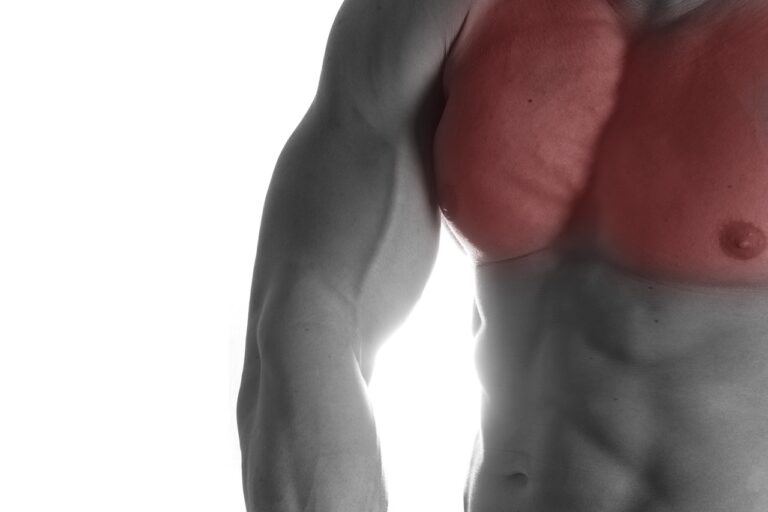
Pectoral muscle: The pectoralis major and minor sit beneath all of it, attached to the ribs and breastbone. Training changes this layer and nothing above it.
The nipple and areola sit on top as their own structure. Both can stretch and widen when tissue underneath pushes outward.
Why Men Have Breast Gland Tissue at All
Male and female bodies start the same way. Early in fetal development, all humans form the same basic breast structures before hormones split the two paths.
At puberty, estrogen drives female breast tissue to develop full ducts and milk-producing lobules. Testosterone suppresses that process in males. Men keep a small amount of rudimentary duct tissue and stop there.
That leftover tissue never disappears, and it stays capable of growth. Give it enough estrogen activity relative to testosterone, and it responds the way breast tissue always responds. It grows.
This is the anatomical reason gynecomastia is common rather than rare. The tissue was always present, waiting for a signal.
How to Tell Gland, Fat, and Muscle Apart
You can learn a lot from a self-exam, though our surgeon confirms it during a proper visit.
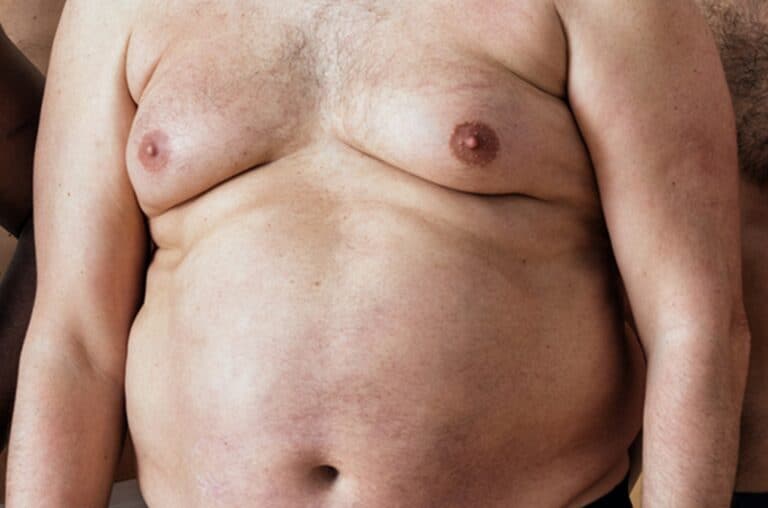
Glandular tissue feels firm and rubbery, almost like a flat disc or a hard button. It sits in a defined circle behind the nipple with a clear edge you can trace. It may feel tender as chest enlargement develops, especially early on, and it often shows up on one side before the other.
Fat feels soft and compressible. It spreads evenly across the chest with no distinct border and rarely causes pain. Body fat percentage controls how much of it you have.
Muscle sits deeper and firms up when you flex. It has a broad, fan-shaped structure that runs from your breastbone to your upper arm.
Most men have some combination of gland and fat rather than one alone. The proportion between them is the single most useful piece of information for planning treatment.

How Male Chest Anatomy Changes With Age
The tissue balance in your chest shifts several times over a lifetime.
During puberty, hormone levels swing before they settle. Many boys develop temporary gland enlargement in that window, and it usually resolves on its own within one to two years as testosterone rises.
In adulthood, the chest stays fairly stable unless something disrupts hormone balance. Anabolic steroids, certain prescriptions, heavy alcohol use, liver disease, and thyroid disorders all shift the ratio between estrogen and testosterone activity.
After midlife, testosterone declines gradually while body fat tends to rise. Fat tissue converts some testosterone into estrogen, which pushes the balance further. Men over 50 notice chest changes frequently for this reason alone.
What Gynecomastia Does to the Tissue
Gynecomastia is not simply extra tissue sitting there. The gland goes through two distinct phases, and the phase you are in determines your options.
The Early Phase
In the first months, the ducts multiply, and the surrounding stroma fills with blood vessels and fluid. The tissue is active, inflamed, and often sore. This is when men notice tenderness with pressure or after exercise.
Tissue in this state can still respond to change. If a new medication or supplement caused it, removal of that trigger sometimes allows the tissue to regress.
The Late Phase
Over roughly six to twelve months, the picture changes. The ducts thin out and dense fibrous tissue replaces them. The gland becomes scar-like, hardened, and permanent.
Fibrous tissue has no hormone response left. Medication stops working at this stage, and no amount of diet or training breaks it down. Your body does not treat glandular tissue as an energy store, so it never burns it for fuel.
This is the anatomical answer to the question most men ask. Established gynecomastia does not go away naturally because the tissue causing it is no longer the kind of tissue that changes.
Where the Gland Sits and Why It Matters
Location shapes the entire surgical plan.
Glandular tissue concentrates directly behind the nipple and areola, then extends outward in a radial pattern. It is densest at the center and thins toward the edges.
That position gives our surgeon a natural place to hide an incision. The border between the areola and the surrounding skin creates a color change, and a scar placed along that line blends into it. Most gynecomastia patients need nothing more than a small incision at the lower edge of the areola.
The tissue also sits above the pectoral muscle rather than inside it. Removal of the gland does not touch the muscle, which is one reason recovery is manageable for most men.
Skin becomes a factor when enlargement has been significant or long-standing. Younger skin often tightens on its own after tissue removal. Skin that has stretched over many years, or after major weight loss, sometimes needs direct tightening.
How Your Anatomy Determines Your Treatment
Different layers call for different tools. Our surgeon matches the approach to what your exam actually shows.
Mostly fat: Liposuction alone works well when the fullness comes from the fat layer. Small cannula incisions remove the soft tissue, and the skin retracts.
Mostly gland: Direct excision through an areolar incision removes the firm disc. Liposuction cannot do this job, because a cannula passes through fibrous tissue without removing it.
Both together: Most men fall here. Liposuction addresses the surrounding fat and contour while excision removes the central gland, in one procedure.
Excess skin as well: Larger or long-standing cases sometimes need skin removal or nipple repositioning to reach a flat result.
Surgeons often describe these situations in grades, running from mild chest enlargement with good skin tone up to marked enlargement with significant skin excess. The grade is a shorthand for the same anatomical question. How much gland, how much fat, and how much skin.
Weight loss still has a place in this picture. It reduces the fat layer and can improve your contour meaningfully if fat makes up a large share of the problem. It does not remove the gland.

Why Training the Chest Can Make It Look Worse
The pectoral muscle sits underneath the gland, not around it. This detail catches a lot of men off guard.
Bench presses and push-ups build that muscle layer. A larger, thicker pec pushes everything above it forward, including the glandular tissue you were trying to flatten. The gland becomes more projected and more visible, not less.
Lean, well-trained men are often the ones most frustrated by what remains. They have already removed the fat layer that used to blend the gland into the surrounding chest, and now the disc stands out on its own.
None of this argues against exercise. It simply explains why the gym cannot solve a glandular problem, no matter how consistent you are.
Your Next Step
Male chest anatomy is not complicated once you know what sits where. Four layers, each with its own behavior, and one of them will not respond to anything except removal.
Our surgeon at the Atlanta Gynecomastia Center can tell you within minutes which layer is driving the shape of your chest. That single answer tends to change how men think about the whole issue, whether it leads to surgery or not.
Schedule a confidential consultation to find out what your anatomy is actually telling you.