
Grade 4 Gynecomastia with Chest Sagging Case Study
Gynecomastia is not just about extra tissue in the chest. In more severe cases, the weight of that tissue starts to pull everything downward. The skin stretches, the areola drifts lower, and the chest develops a drooping shape that goes well beyond simple fullness. That is exactly what Grade 4 gynecomastia looks like on this patient.
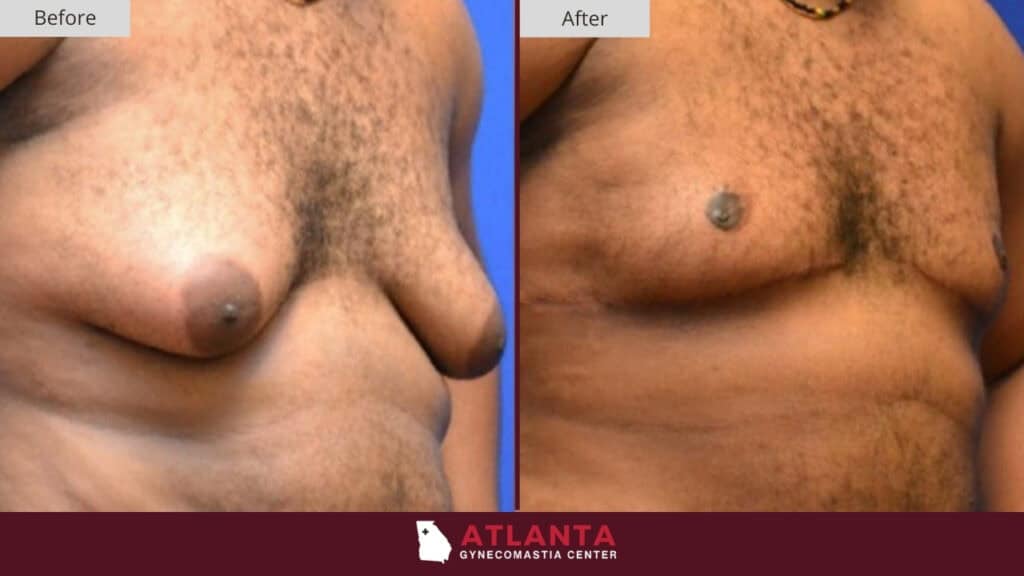
This is a larger-framed male with Grade 4 gynecomastia that caused both significant volume and visible sagging. The before and after photos show a major transformation, with a far flatter chest and a shape that looks completely different from where he started.
What Happens When Gynecomastia Gets to Grade 4
Grade 4 is the highest classification on the gynecomastia grading scale. At this stage, the chest has taken on a shape that closely resembles a female breast. The tissue is not just full. It hangs. The skin has been stretched by the weight of the tissue over time, and the areola has been pulled downward along with it.
This does not happen overnight. Grade 4 cases are usually the result of years of tissue growth that gradually adds weight and stretches the skin further and further. The longer it goes untreated, the more the skin loses its ability to snap back on its own.
Breaking Down the Before Photo
The side view on this patient shows a large amount of tissue hanging well below the natural chest line. The breast mound extends outward and downward, creating a heavy, pendulous shape. The lower border of the tissue sags past the point where the chest should end and the abdomen begins.
The areola has also shifted downward with the tissue. Instead of sitting in the center of the pectoral area, it points toward the floor. That downward drift is one of the hallmarks of Grade 4 cases and one of the things our team pays close attention to when planning the correction.
The skin itself is visibly stretched. After carrying this much tissue for an extended period, the skin has lost a good amount of its natural tightness. That plays a big role in how the surgery is approached and what the realistic expectations are for the final result.
How Our Team Approached This Case
For a Grade 4 case with this much volume and sagging, our team used:
- Gland excision: The glandular tissue was removed directly to eliminate the root cause of the enlargement. In a case this severe, there is typically a large amount of dense tissue behind the areola that has to come out before anything else can be addressed.
- Liposuction: The fatty tissue throughout the chest was removed to bring down the overall volume. On a larger frame with Grade 4 gynecomastia, the amount of fat mixed in with the gland can be substantial, so the lipo portion of the procedure plays a major role in reshaping the contour.
- Skin excision: With this much tissue removed, the stretched-out skin would not be able to tighten down on its own. Our team removed the excess skin directly to create a flatter, cleaner result. Without this step, the chest would be smaller in volume but still loose and saggy.
One of the biggest challenges in a case like this is managing the skin. When a large volume of tissue is removed, the skin that was stretched around it has to tighten down over a much smaller surface area. How well it does that depends on the patient’s skin quality, age, and how long the tissue has been there.
Breaking Down the After Photo
The after photo shows a dramatically flatter chest. The heavy, hanging shape from the before photo is gone, and the tissue no longer sags past the chest line. The overall contour of the chest is much closer to a normal male shape, and the improvement is obvious even at this early stage.
The areola has moved back to a more natural position closer to the center of the pectoral area. It no longer points downward, and it lays much flatter against the chest wall. That shift alone makes a huge difference in how the chest looks overall.
There is still some skin laxity present, which is normal at this stage of healing. The skin will continue to tighten over the coming months as the body adjusts to the new contour. The combination of skin excision during the procedure and natural retraction over time gives the best possible outcome for a case at this level.
What Severe Cases Need
Grade 4 gynecomastia requires an experienced surgical team that understands how to handle large volumes of tissue, manage skin, and create a balanced result. Every case at this level is different, and the plan has to account for the full picture, not just the tissue removal.
Our team at the Atlanta Gynecomastia Center treats severe cases regularly and builds each plan around the individual patient’s anatomy. If you are dealing with advanced gynecomastia and are not sure where to start, schedule a consultation with our team to talk through your options.